Keywords
Ore waste Detection
RepLKNet
NAM
SIOU
How to Cite




Abstract
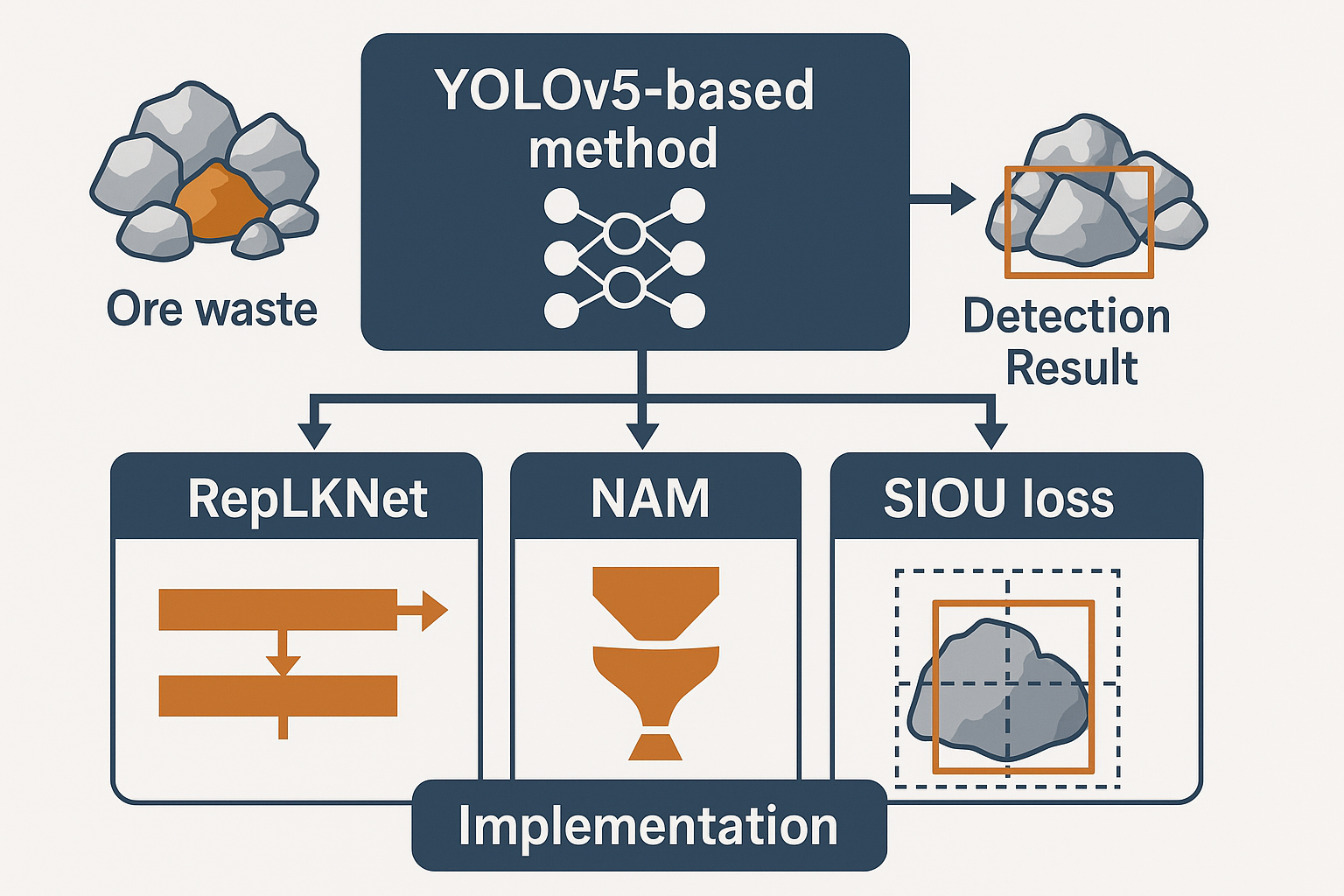
Detection of ore waste is crucial for achieving automation in mineral metallurgy production. However, deep learning-based object detection algorithms encounter challenges in iron scrap screening and removal detection due to the complex operating environment in mines and the limited resources of large-scale computing equipment, resulting in prolonged computation times and unsatisfactory detection accuracy. To address these challenges, this paper proposes an ore waste detection algorithm based on an improved version of YOLOv5. To enhance feature extraction capabilities, the RepLKNet module is incorporated into the YOLOv5 backbone and neck networks. This module enhances the deformation information of feature extraction with the maximum effective Receptive Field to increase the model's accuracy. The Normalization-based Attention Module (NAM) was introduced to enhance the extraction of relevant features from detected objects while suppressing irrelevant features, thereby further improving detection accuracy and reducing model parameters. Additionally, the loss function is optimized to constrain angular deviation using the SIOU loss function, which prevents the training frame from drifting during training and enhances convergence speed. To validate the performance of the proposed method, we tested it using a self-constructed dataset comprising 1,328 images obtained from the crushing station at Jinchuan Group's No. 2 mine. The results indicate that, compared to YOLOv5s on the self-constructed dataset, the proposed algorithm achieves an 18.3% improvement in mAP (0.5), a 54% reduction in FLOPs, and a 52.53% decrease in model parameters. The effectiveness and superiority of the proposed algorithm is demonstrated through case studies and comparative analyses.

This work is licensed under a Creative Commons Attribution 4.0 International License.
Copyright (c) 2025 Kaiyu Yan, Juan Wang, Jia Wang, Dawei Tian, Kaiyu Yan, Shu Peng, Yunhua Xu