Keywords
distributed testing
industrial control systems
system integration
SharkNet
How to Cite




Abstract
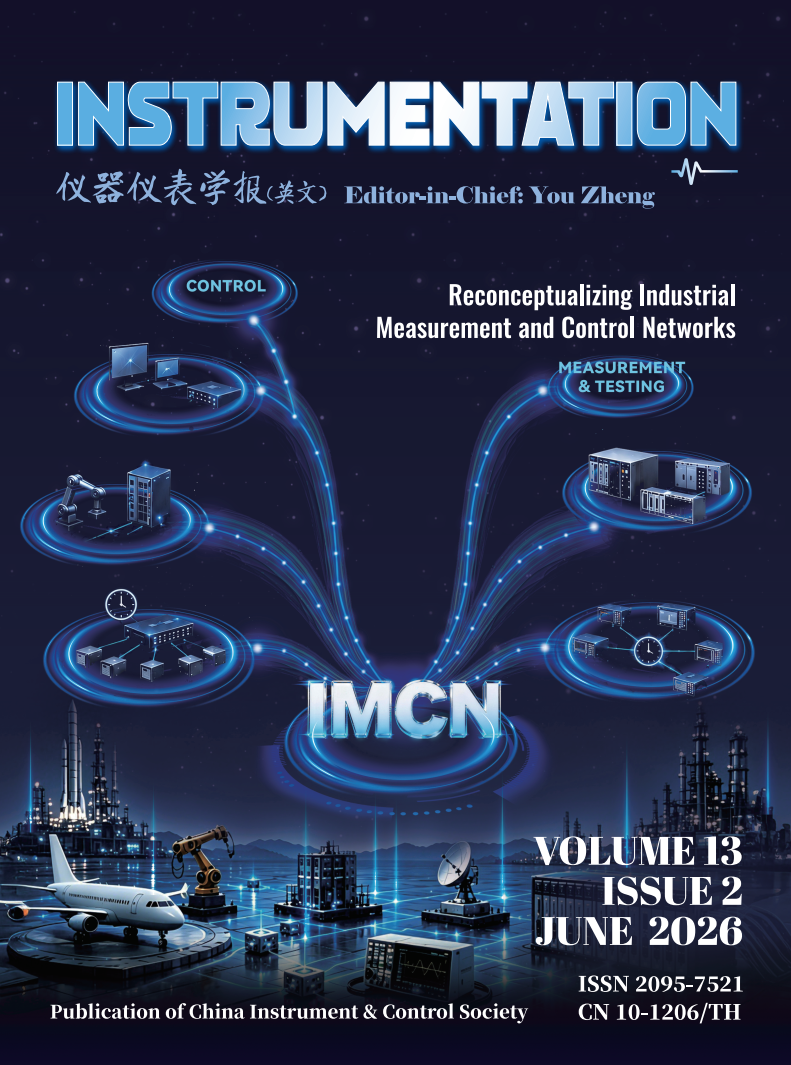
Driven by the growing needs of high-end equipment manufacturing, complex system verification, and distributed testing, industrial networks are moving beyond device connection and data communication to support deterministic control, real-time data exchange, and coordinated testing. Although deterministic communication technologies have improved time-critical transmission, local synchronization, and priority control, existing industrial control networks still face limits in wide-area distributed testing, multi-source synchronous acquisition, transient event capture, flexible scheduling, and dynamic adaptation. To address these challenges, the evolution of industrial networks is reviewed, and the fundamental differences between test-and-measurement tasks and logic-control tasks are compared in terms of service features, trigger modes, time references, and system boundaries. On this basis, a conceptual framework for industrial measurement and control networks (IMCN) is proposed. The framework defines ten core capabilities: synchronous execution, synchronous acquisition, precise time capture, strict priority assurance, sensor network support, deeply embedded built-in testing, adaptive multi-source timing, dynamic topology reconstruction, network-shared storage, and a native networked instrumentation bus architecture. It also highlights the connotations in four aspects: inheritance, testability, traceability, and autonomy. The applicability and practical value of the proposed conceptual framework are further illustrated through the case of SharkNet in aerospace and other high-end measurement and control systems, while its potential significance for self-organizing, reconstructible, and brain-inspired physical network architectures is also discussed.

This work is licensed under a Creative Commons Attribution 4.0 International License.
Copyright (c) 2026 Kun Geng, Yueyan Qi, Yingzi Zhang, Qiang Li, Gaigai Liu, Fei Li, Kangwei Chu, Yingping Hong, Huixin Zhang, Yanjun Zhang, Haifeng Hu, Lisheng Liu, Jianyun Ren, Wenyi Liu
Downloads
Publication Facts
Reviewer profiles N/A
Author statements
- Editor & editorial board
- profiles
- Academic society
- China Instrument and Control Society
- Publisher
- China Instrument and Control Society

To learn about these publication facts, click 
PF is maintained by the Public Knowledge Project