Keywords
horned lizard optimization algorithm
multilayer perceptron
fault diagnosis
photovoltaic monitoring
How to Cite




Abstract
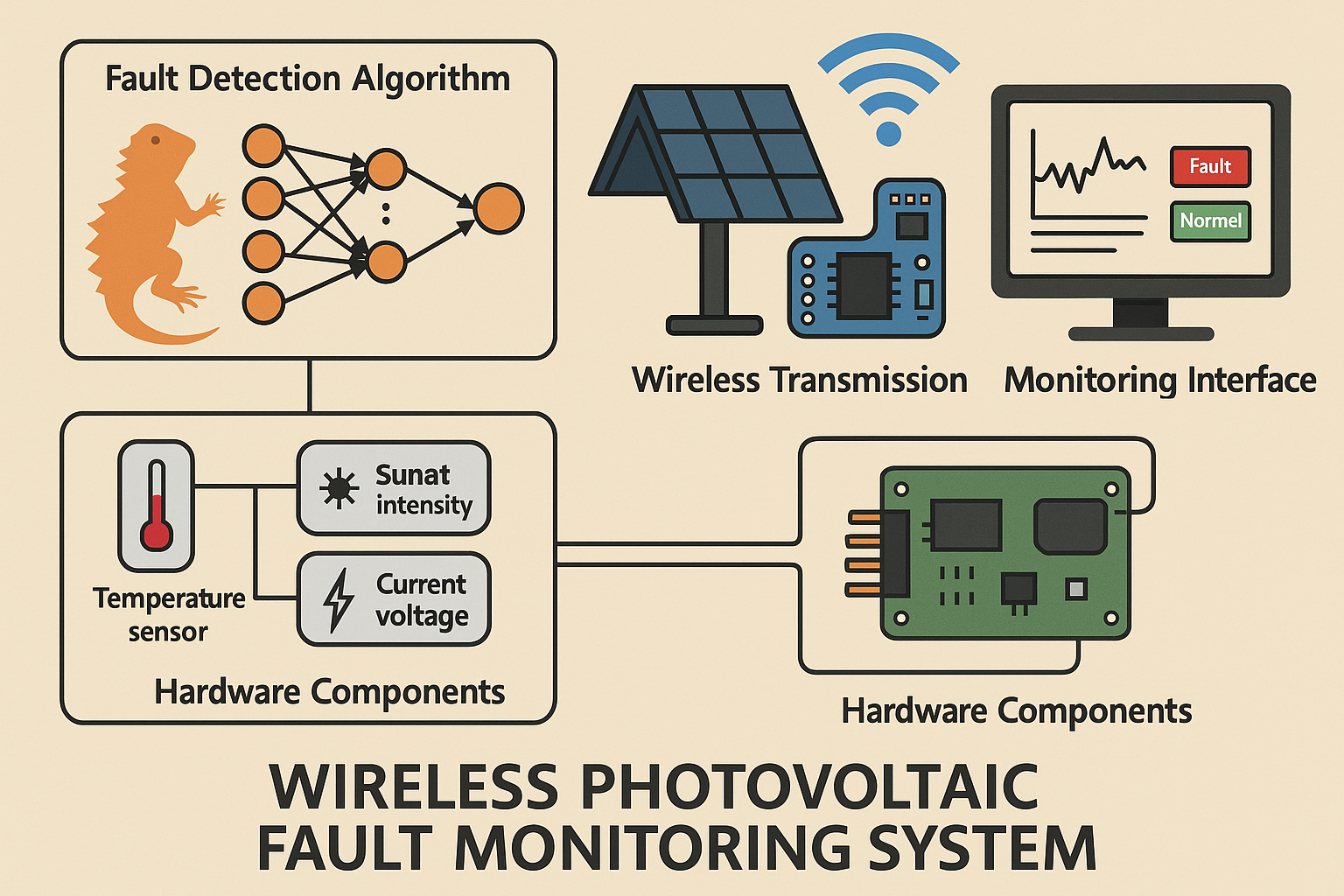
This study presents a wireless photovoltaic fault monitoring system integrating an STM32 microcontroller with an Improved Horned Lizard Optimization Algorithm (IHLOA) and a Multi-Layer Perceptron (MLP) neural network. The system comprises both hardware and software components. The hardware includes sensors such as the BH1750 light intensity sensor, DS18B20 temperature sensor, and INA226 current and voltage sensor, all interfaced with the STM32F103C8T6 microcontroller and the ESP8266 module for wireless data transmission. The software, developed using QT Creator, incorporates an IHLOA-MLP model for fault diagnosis. The user-friendly interface facilitates intuitive monitoring and scalability for multiple systems. The IHLOA algorithm, inspired by horned lizard survival strategies, optimizes the MLP parameters, enhancing fault detection accuracy and robustness. Experimental results indicate that the IHLOA-MLP model improves fault detection accuracy by 2.61% and reduces variance by 63.64% compared to traditional MLP models, demonstrating superior stability. The system selects voltage as a feature vector to maintain circuit stability, avoiding efficiency impacts from series current sensors. This combined hardware and software approach increases monitoring efficiency, while an auxiliary judgment count mechanism reduces misjudgment, effectively achieving photovoltaic array fault monitoring. This implementation enhances photovoltaic system stability and safety, supporting the advancement of renewable energy technologies.

This work is licensed under a Creative Commons Attribution 4.0 International License.
Copyright (c) 2025 Wenbo Xiao, Huangfeng Dong, Huaming Wu, Yongbo Li, Bin Liu