Keywords
Magnetic flux leakage
Electromagnetic ultrasonic testing
Eddy current testing
Pipeline integrity assessment
How to Cite




Funding data
-
Key Programme
Grant numbers 62531017 -
National Natural Science Foundation of China
Grant numbers 62371315 -
Natural Science Foundation of Liaoning Province
Grant numbers 2025-MS-117 -
Key Research and Development Program of Liaoning Province
Grant numbers 2024JH2/102500072 -
Youth Science Fund Project
Grant numbers 62301341 -
Department of Science and Technology of Liaoning Province
Grant numbers 2025JH2/101300013 -
Department of Education of Liaoning Province
Grant numbers 200080762/070
Abstract
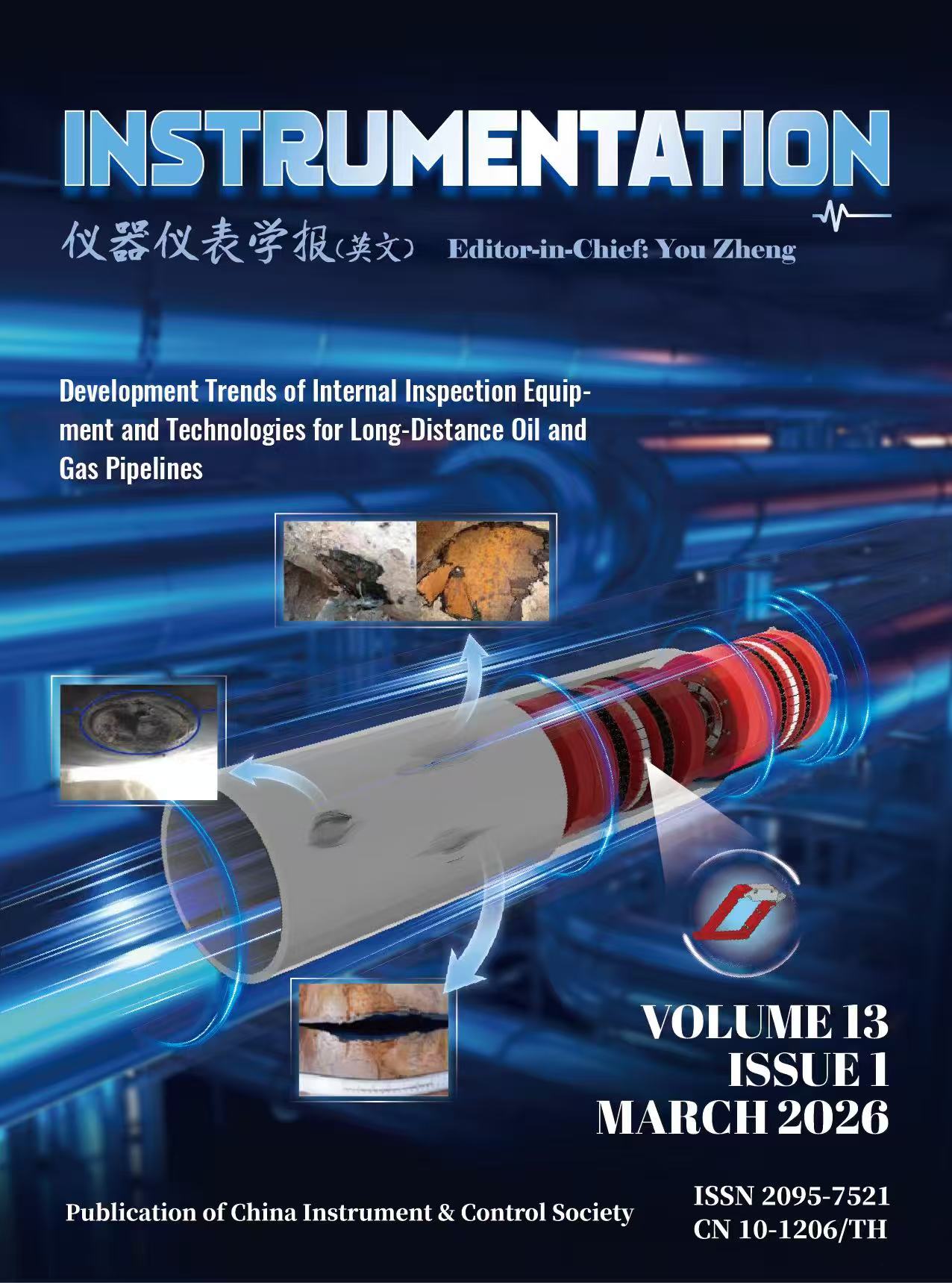
As critical national infrastructure, oil and gas pipelines are hailed as "energy arteries". In-line inspection (ILI) is internationally recognized as the most effective method for pipeline safety maintenance. This paper sorts out and compares the current mainstream pipeline ILI technology systems, including diameter variation, Magnetic Flux Leakage (MFL), weak magnetic, dual magnetic field, eddy current, balanced electromagnetic, piezoelectric ultrasonic, and electromagnetic ultrasonic technologies, covering mainstream pipeline damage types such as geometric deformation, corrosion, wall thinning, stress concentration areas, composite defects, surface and near-surface cracks, buried microcracks, and weld cracks. Among them, diameter variation detectors mainly target pipeline geometric deformation and are mostly used for passability auxiliary judgment before ILI construction; MFL detection features fast speed, high sensitivity, mature theory, and strong penetration, enabling efficient detection of macro volume defects such as corrosion; weak magnetic and dual magnetic field technologies can identify stress concentration areas, but MFL, weak magnetic, and dual magnetic field methods are only applicable to ferromagnetic materials, and the quantitative relationship between magnetic signals and defects needs further improvement; eddy current and balanced electromagnetic methods excel in high-precision detection of surface and near-surface cracks in conductive materials with relatively fast detection speed, and the current core challenges are enhancing deep defect penetration capability and reducing the interference of lift-off value on signals; piezoelectric ultrasonic and electromagnetic ultrasonic technologies have a wide material adaptation range and high detection precision, and can assist in identifying composite defects and weld cracks. However, piezoelectric ultrasonic relies on couplants, has strict requirements on the flatness of the detection environment, and relatively low detection speed. The current key challenge lies in improving the signal-to-noise ratio through signal processing. Based on different principles, various technologies form a complement to each other, jointly constructing a detection system with wide coverage and strong adaptability. By elaborating on the principles, performance characteristics, application scenarios, and domestic and foreign research trends of each technology, this paper clarifies the positioning and advantages of different technologies in pipeline damage detection, providing clear technical selection references for pipeline safety maintenance personnel and helping to improve the scientificity and efficiency of oil and gas pipeline safety operation and maintenance.

This work is licensed under a Creative Commons Attribution 4.0 International License.
Copyright (c) 2026 Bin Liu, Zheng Lian, Ye Tian, Xinyang Dong, Rongxue Li, Liyao He, Meng Li, Lijian Yang
Downloads
Publication Facts
Reviewer profiles N/A
Author statements
- Editor & editorial board
- profiles
- Academic society
- China Instrument and Control Society
- Publisher
- China Instrument and Control Society

To learn about these publication facts, click 
PF is maintained by the Public Knowledge Project